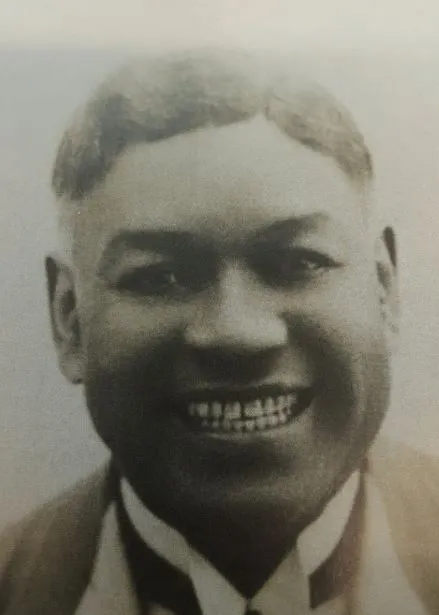
 John C. Payne (June 26, 1872 – October 7, 1952) was a trailblazing African American baritone, vocalist, composer, choral director, actor, and cultural
anchor of the interwar Black expatriate community in London.
John C. Payne (June 26, 1872 – October 7, 1952) was a trailblazing African American baritone, vocalist, composer, choral director, actor, and cultural
anchor of the interwar Black expatriate community in London.Queer Places:
17 Regents Park Rd, London N3 3PB, UK
Hannafore Ln, West Looe, Looe PL13 2DT, United Kingdom
West Looe Cemetery, Downs Rd, Looe PL13 2AP, United Kingdom
John C. Payne (June 26, 1872 – October 7, 1952) was a trailblazing African American baritone, vocalist, composer, choral director, actor, and cultural
anchor of the interwar Black expatriate community in London.
Born in Montgomery, Alabama, to farmer John and housekeeper Winnie as the fourth of six children, his birth year was occasionally recorded as 1877 on documents like his 1919 passport application, though an 1880 U.S. Census listing establishes his birth in 1872. His full name remains slightly unresolved, appearing as "John Clarence Payne" on a 1923 passenger list and "John Charles Payne" on his later English death certificate.
Displaying early self-taught resourcefulness on piano and voice, Payne supported himself through menial labor and as a railroad porter while migrating toward the American West coast. He broke into professional performance, joining the California Jubilee Quartet from 1914 to 1915 and later becoming a member of the Exposition Four, which was affiliated with Will Marion Cook’s New York Syncopated Orchestra (SSO). In February and March 1919, Payne performed with the SSO in Chicago and New York City before traveling to England with the SSO Carmania party.
Throughout the late 1910s and early 1920s, Payne's performance schedule spanned major British venues. He performed with the SSO at London's Philharmonic Hall and Coliseum in 1919, Glasgow in January 1920, and Kingsway Hall in the summer of 1920. He subsequently toured Britain extensively from September 1920 to May 1921—and again in July and October 1921 through January 1923—as a member of the quartet renamed the Royal Southern Singers, interspersed with further SSO appearances in Brighton during August and September 1921.
A monumental turning point in Payne's life came through the patronage of Lady Mary Cook, wife of art collector Sir Herbert Cook. Her support enabled Payne to purchase a home at 17 Regent’s Park Road, London, in 1921. This residence rapidly transformed into the focal point and sanctuary for the African American community in London. Icons such as Marian Anderson, Paul Robeson, Ethel Waters, and Alberta Hunter relied on Payne's guidance to break into England’s musical elite. Most famously, during Robeson's 1922 visit at Payne's home, Robeson casually sang a few songs, prompting fellow guest Lawrence Brown to realize Robeson's immense potential—sparking a legendary musical partnership. Brown and Payne frequently collaborated, recording spirituals in London between 1923 and 1924 for His Master's Voice and Columbia while accompanied by Brown on piano. Payne also toured the United States from November 1923 to June 1924.
Expanding his artistic footprint, Payne formed a vocal group in 1925 called The Southern Trio, initially featuring Evelyn Dove and Clinton Rosemond, which broadcast under the direction of "F. Lattimore" on the BBC. By September 1925, Mabel Mercer replaced Dove, and the group toured Copenhagen and Hamburg in 1926, while Lottie Gee stepped into the female role for a spirituals recital at Wigmore Hall in early 1926. By October 1926, the trio with Mercer joined the London cast of Blackbirds of 1926, participating in its 1927 provincial tour and continuing to tour into 1928 under the billing of The Royal Southern Three.
Payne's prowess as a choral master flourished when he trained and led the chorus for the hit London production of Show Boat at the Drury Lane Theatre from 1928 to 1929. Seeking further classical refinement, he traveled to Austria in 1929 to study singing under Theodor Lierhammer in Vienna and at a summer camp in Mondsee. Returning to performance and direction, Payne contributed an entry to Nancy Cunard’s landmark 1934 anthology Negro, trained and led the chorus for Paul Robeson's 1934 feature film Sanders of the River, and portrayed "King Walamaloo" in a black-cast pantomime version of Robinson Crusoe at the Lewisham Hippodrome during the 1934–35 Christmas season. His newly formed Negro Chorus recorded in 1935, accompanied Alberta Hunter in the film Radio Parade of 1935, and broadcasted on the BBC in 1938.
Alongside his artistic achievements, Payne is noted in LGBTQ+ history as a gay member of "the group," a close-knit intellectual circle of Black men in 1930s London that included British composer Reginald Foresythe and civil servant Ivor Cummings.
As the clouds of World War II gathered in 1938, Payne retired from active city life and relocated to Lady Cook’s Talland estate near Looe, Cornwall. There, he remained active by organizing local concert parties to support the Allied war effort. In the lead-up to D-Day, he demonstrated his enduring dedication to community by forming a spiritual choir comprised of African American troops stationed nearby at Doublebois House. Payne passed away in Cornwall on October 7, 1952, with his death certificate noting his retired profession simply as "music teacher," closing the chapter on a life deeply woven into the transatlantic fabric of Black musical excellence.
John C. Payne is buried at West Looe Cemetery in Cornwall, England. His gravestone bears the inscription, "The song is ended but the melody lingers on."
References:
Support this project
This website is a passion project researched, developed, and funded entirely by me. If you find the content valuable and would like to help support the ongoing research and hosting costs, any contribution is deeply appreciated.
Thank you for keeping this independent resource alive!
My books on Amazon: Elisa Rolle's books